








Blog

It’s So Good to See You!

October 4, 2012

By: Stephanie Duhon

“Hello everybody, it’s so good to see you …” I can’t get this song out of my head because Nicole has requested the “good to see you song” every day for the past week! We have to say hello to the family and all of her stuffed animals!

Nicole had a great time during Prelude class on Friday. We sang “Crawdad,” which is her favorite song after the “Hello Song.” She really gets into the song and is requesting that one a capella lately too. Guess my singing isn’t too bad if she constantly wants to hear me sing!

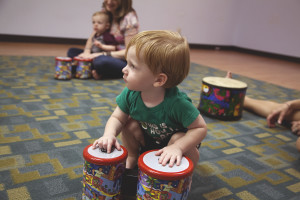
Prelude Class One thing I’ve noticed about Nicole this semester compared to semesters past is how much she concentrates on choosing instruments during free play. She used to just play whatever I would play, usually a drum or sticks, or sometimes nothing at all! Now, I’ve noticed she plays one instrument for a bit, puts it down for another and ends up playing 3 or 4 instruments during the song instead of one. She also pauses for a minute, like she is listening for the beat before playing. It’s these small, but significant, changes I’m noticing that make me realize just how much she is learning in each class, even when it seems like she is not paying much attention.

I also enjoy how much I am learning about music in this class. Emily mentioned that most music is in a major key with 2 beats. It’s the format most people are familiar with. Music Together® offers songs in a variety of formats: major key, minor key, ending on a resting note and various rhythms. The purpose is to expose children to as many formats of music as possible so they will develop full music competence. Emily also mentioned that babies pick up resting notes first and it’s often the first note you’ll hear your child use.

Learning music reminds me a lot of how you learn a foreign language. The earlier you learn (especially before age 5), the easier it is to pick up that language and the better the pronunciation. I grew up in Cajun Country and have studied French since I was a little girl. While I did fine in school, I didn’t really pick up the language and feel somewhat fluent until I did an immersion program in high school. When I was completely surrounded by the language 24/7, I realized just how much I knew from having been exposed to the language at an early age. I bought some French language children’s books for Nicole with the hopes of introducing her to French early too so that she will be able to more easily pick up any of the Romance languages later. True fluency comes with time and practice, for languages and music.

Social Share Toolbar

Baby Safety Month: Why You Should Take an Infant, Child and Adult CPR Class

October 3, 2012

By: Stephanie Duhon

Having or taking care of a child means you are responsible for that child’s welfare. Do you know what to do if the child starts choking or stops breathing? According to the National Safety Council, choking and suffocation is the third leading cause of unintentional injury death for infants under age 1. Babies put anything in their mouths. It’s part of how they learn the world around them. Keeping small objects out of baby’s reach is the best way to prevent an injury, but it’s still crucial to know what to do in an emergency situation just in case. A CPR class can teach you life-saving techniques.

The Motherhood Center offers the American Heart Association’s Family and Friends CPR course. The class teaches techniques such as the Heimlich maneuver, chest compressions and basic first aid. While there are many websites that cover basic CPR, this class gives you actual hands-on training and a chance to ask questions. Each attendee practices with an infant-sized doll to better understand how to properly do each maneuver. The instructor goes over the differences between treating an infant, a child or an adult. The basics of using an Automatic External Defibrillator (AED) are also covered. This knowledge is especially useful for people who work on a campus or in an office building with access to an AED.

In addition to parents, we recommend that anyone caring for your baby, such as grandparents or babysitters, should take a CPR class. Infant, Child and Adult CPR is offered twice a month on Mondays and Saturdays. You can find our more or register here.

Sources:

http://www.nsc.org/safety_home/HomeandRecreationalSafety/Pages/Choking.aspx

Social Share Toolbar

I’ve Got Rhythm … How About You?

September 24, 2012

By: Stephanie Duhon

Nicole was a bit crabby as we arrived for our Prelude Music class Friday morning. I’m not sure why, but she was just in one of those moods. Thankfully as soon as Miss Emily began playing the “Hello Song,” she perked up and it was not long before she was spinning around in the middle of the circle dancing away!

Prelude Music Class One of the first songs we sang this week is an old favorite of mine … “This Little Light of Mine.” Often Nicole roams around the room, but for this song, Nicole sat down quietly and was enthralled watching and listening to Miss Emily sing. She actually sat still long enough for me to snap a picture! Later in the class, she really got into “Singin’ Every Day.” She started dancing in a circle with her arms out. So cute! I love how she responds to each song in such a different way.

It amazes me sometimes how it seems so much easier for Nicole and the other kids to keep the beat than it is for me! I often end up being slightly off beat by the end of the song, especially if we are all singing different parts. But one added perk of the class is I feel my musical ability is improving with every class too!

It’s a good thing I’m feeling more confident in my own singing ability because Nicole has started requesting that I sing the “bah-bah” songs. I certainly have many opportunities to learn them. We listened to the Music Together® CD every day last week, sometimes more than once! So far, her favorites from this collection are “Crawdad,” “A Ram Sam Sam,” “Sweet Potato,” “I’ve Got the Rhythm in My Head” and “Singin’ Every Day” (anyone see a trend?). She likes me to sing “Sweet Potato” and the “Hello Song.” We have to sing hello to everyone in the family!

The Music Together CD has also helped us with a new bedtime issue. Nicole usually does well going down for her nap and at bedtime, but this past week, she has been finding every excuse to delay bedtime (she needs water, she wants to rock, she’s missing a stuffed animal, etc.). My husband and I decided to try a “bah-bah” CD and it worked! Now she walks into her room before nap or bedtime and turns on the CD player to start the music. She can’t wait to talk to her stuffed animals while listening to her CD before falling asleep!

Social Share Toolbar

Baby Safety Month: Baby proofing Your Home

September 20, 2012

By: Stephanie Duhon

Babies are naturally curious. They learn through all the senses: touch, smell, taste, sight and sound. That’s why baby proofing is crucial. Babies don’t know what is safe to touch or taste. They all have a stage where they will put anything in their mouths. As babies become toddlers, they run around, climb on furniture and pull down anything within their reach.

An estimated 22 million children are hurt in accidents in their homes and yards each year. According to Consumer Product Safety Commission, more than 16,000 children under age 5 went to ER in 2006 with injuries caused when furniture fell on them, such as TV sets, bookcases and other appliances. The good news? Many of these accidents can be prevented with a few simple precautions.

Experts recommend parents begin baby proofing before your baby can crawl and to modify the baby proofing as the child gets older.

Baby proofing tips:

-Install electrical outlet plugs

-Lock all windows

-Remove or shorten any cord within reach (Blind or drape cords can cause strangulation)

-Secure furniture so it can’t fall or tip over

-Keep older kid’s toys out of baby’s reach

-Keep all cleaners, medicine and makeup out of reach

-Never leave water sitting in a tub

-Place smoke and carbon monoxide detectors in home (one per floor)

-Put up baby gates if you have stairs or want to block off an area of the house

-Cover sharp corners with corner guards (such as coffee tables or end tables)

-Keep floors clean and vacuumed (make sure there are no small items lying around, such as buttons or marbles)

-Make sure garbage can has a tight lid

-Install latches to keep cabinets/drawers closed

Not sure what else your baby can reach? Get down on all fours and crawl around to see your home from your baby’s point of view. What items are within reach? What would be tempting to a young child? As your baby begins walking, get down to their new level and look again. Child proofing is an ongoing process.

Child holding cookie boxAnd keep in mind that accidents will still happen. Toddlers who are just learning to walk are often clumsy and may fall. And I know from personal experience that kids can often get into mischief faster than you can turn around! I am extremely vigilant about keeping an eye on my daughter. I am always worried she will hurt herself, but children are fast! I remember one time I was cooking dinner and my daughter was on the floor playing with some pots. She had just started walking and I learned that day, she also knew how to climb! I had left a box of cookies on the table and next thing I knew she was ON THE TABLE WITH THE BOX OF COOKIES! She didn’t get hurt, but it reminded me to make sure my table is always clear so there is no temptation for her to climb where she shouldn’t. These small, but significant, safety measures will at least help reduce the risk of severe accidents.

Sources:

Babyzone.com

CPSC.gov

CDC.gov

Social Share Toolbar

To Thine Own Self Be True

September 18, 2012

by: Kimberly Bowman

The definition of selfish is: “concerned chiefly or only with oneself, without regard for the well-being of others.” Think about the last time you heard someone identified as selfish. Was the description accurate? Often times when we use this label we are actually talking about someone (usually a woman; the words we use to describe this same trait in men generally have a different flavor.) who is protective of their energy, time and sanity or they simply have a good handle on their capabilities.

Our limits are something that through the experiences of life we hopefully come to understand and learn to stay within. In doing this we protect ourselves from sure destruction. This phenomenon is called self-preservation. For many women this is difficult. There are many metaphors – if you only make withdrawals and not enough deposits, eventually the bank will be empty, learn to exercise your “no” muscle, a tree with enough chops at its trunk will someday fall, etc. etc.

When we try to please everyone one of two things will happen. You will either try to do it all, inevitably fail all the while punishing those you are trying to please for their lack of comprehension that you are there to make their lives more wonderful, or you will try to do it all, inevitably fail and end up in the fetal position in the back of your minivan amongst the groceries and the mulch. Both scenarios end with everyone neither helped nor pleased.

The metaphor about exercising your no muscle is a favorite. Like everyone else, we were probably quite adept at using this word when we were toddlers but along the way seemed to get the impression that we should instead be saying oh, of course, yes, absolutely, sure, I can be there, do that. Saying no is not about selfishness or being a charity miser. It is not about lack of manners or laziness. It is about guarding your soul. It is about knowing who you have time for. Since they are the one in the mirror and those most precious to you, that knowledge is golden.

Social Share Toolbar

It’s Time to Sing and Dance!

September 17, 2012

By: Stephanie Duhon

“It’s “bah-bah” time!” exclaimed my 2-year-old daughter, Nicole, as we drove up to The Motherhood Center for our first Prelude Music class of the semester.

Nicole LOVES to listen and dance to music. Her daddy plays piano and guitar, so she has been exposed to music since before she was born. In fact, my husband used to sing to her while she was still in my belly and she would kick or move around in response!

So it’s no surprise that Nicole feels right at home in a Prelude Music class, where we learn the Music Together® curriculum. This is our third semester of the program and she becomes more comfortable with the class and format each session. We listen to our Music Together® CDs pretty much every day, especially in the car. If my husband or I put the radio on, it takes less than a minute for Nicole to request her “bah-bah” CD! If we are at home, she specifically asks for the “spin around” songs, or the upbeat ones, so she can dance in a circle. I know that I, for one, am thankful for multiple collections of Music Together so that we can switch out the CDs every now and then!

If you’re wondering why she calls her Music Together CDs “bah-bah” … it comes from a tonal pattern she picked up during our first semester. She was just learning some words and phrases and “bah-bah” was how she related to the classes. Now she can ask for the CD itself, but often just says she wants to dance to “bah-bah” since she knows I understand what she wants!

The first day of the Fall semester did not disappoint. I think the Fiddle collection just might be my favorite so far, and I haven’t even heard the entire CD yet! I grew up in South Louisiana, so hearing the fiddle makes me feel at home. One of the first songs we sang was “Crawdad.” What a fun and upbeat song! In the past, Nicole would usually just observe on the first day since the songs are unfamiliar, but this time, she seemed more comfortable and danced a little bit. Not as much as she dances at home, but more than she has before in the first class of a session.

I think Nicole’s favorite song from the first class was “Apples and Cherries.” She loves fruit and got really excited and was trying to tell Ms. Emily how much she loves blueberries and strawberries as we sang the song! I appreciate how the songs are so relatable to the children.

I know we’ll be hearing a lot of “bah-bah” this week as we get to know the songs from the Music Together Fiddle collection. Can’t wait for next week’s class!

Social Share Toolbar

Preparing Big Brother or Sister for a New Sibling

September 10, 2012

by: Angie Graumenz

Sibling Harmony

Parents often take classes to prepare for the arrival of a new baby, but what about siblings? In TMC’s sibling class, children learn about how their family is about to change. We show big brother or big sister what to expect when the new baby comes home. Each child will get to practice feeding, changing, swaddling and holding a baby doll. We will show a short movie about a real baby who changes and grows. Children in the class will get to draw a picture of their new family and get their picture taken for our new bulletin board of Brothers & Sisters at TMC.

According to the U.S. National Library of Medicine’s National Institutes of Health website, “a review of the recent literature substantiates that sibling preparation classes help to ease the transition into being a sibling. Studies have shown that as a result of this preparation, children who become siblings exhibit fewer anxieties, are better able to express their feelings, and the mother feels better able to cope with the older child when the infant arrives.”

Interested in learning more? The next session of Sibling Harmony is September 14. Register today!

Social Share Toolbar

Ringing with Joyful Music!

September 7, 2012

by: Ana Trevino-Godfrey
When I’m asked why music is important to me, Plato’s wisdom comes to mind.  He eloquently said “Music gives a soul to the universe, wings to the mind, flight to the imagination, and life to everything.”  I can’t think of a better way to describe what music does to each one of us.  Parenting has been the greatest and most important part of my life and I am so thankful to have music as a way to communicate and bond with my own children.  I see this happen in every Prelude Class and it brings great joy to my life.

Prelude MusicThis coming week, The Motherhood Center will ring with joyful music that brings families together.  Prelude Music Classes for Children teaches Music Together® classes.  Music Together is an internationally recognized music and movement program for children and the adults who love them.  It is a research-based program that believes all children are musical and all children can achieve basic music competence (that is, the ability to sing in tune and move to an accurate rhythm).

How young can children begin?
Pre-birth!!  Yes, your infant is ready for this class because YOU will be doing the work.  We (the teachers) will model for you and you will model for your child.  Your infant will absorb all of the music around him/her and will be stimulated by all of the movements we do.  Every song we sing and every moment we make has a reason.  We are either teaching major, minor or a different mode; duple, triple or irregular meter; or doing movements that cross midlines so we can stimulate both sides of the child’s brain.  We have classes for babies only (from birth to 8 months), mixed-age classes (birth to age 5) and big kids classes (ages 5, 6 and 7).
All of our teachers are highly qualified to teach and guide you.  We believe you are your child’s greatest and most important influence, so we make sure we teach you how to bring this program home.  Tuition includes ten classes, a book with all the music, two CDs, a parent education class, parent education materials, and entrance to two concerts for the entire family to enjoy!
Come make music with us!  Music is good for all of us- from pre-birth until our last days.  Come make lifelong memories with your children!  Classes begin this Monday, Sept. 10th!  To register, please visit: www.motherhoodcenter.com

Social Share Toolbar

Stand Tall Mama

September 4, 2012

by: Kimberly Bowman

Breastfeeding and mothering in general take a toll on your posture. This likely has its root in the havoc played on your abs during pregnancy. Add in the hunched over state of many a newly breastfeeding mom. Then watch as she rocks on her feet, legs apart, hips shoved forward, belly out to support the little pumpkin as arm muscles give out. The look gives Quasimodo a run for his money. How do they always know when we sit down?

All these subtle moves towards the mommy slouch can be remedied. Posture while breastfeeding, in particular, not only affects your comfort but baby’s latch as well. Baby should be brought to the breast, not breast leaned into baby’s mouth. We are upright humans with our mammary glands near our faces, for a reason. We will not call upon our inner cows and nurse while staring across the landscape instead of at our babes. No offense to cows meant. When you nurse, sit comfortably with your back straight and pull the baby towards your breast, stomach to stomach and take in the wonder that is them while they return the favor.

When rocking ceaselessly on your feet, keep your carriage lifted, lock your abs by drawing your belly button back and up, or belly button to spine. Also, keep your shoulders away from your ears and scapula (or shoulder blades) in your back pockets. These are all Pilates’ mantras and have to do with the strength of your core. These simple tricks can help you to better identify those parts of your body and call upon them when needed and also help to alleviate the stress we carry in our necks and shoulder muscles.

When it comes to your belly, the goal right now is not a lean six-pack. Pregnancy gives many women about ten pounds to use as lactation fuel. You may keep this extra weight for the duration of breastfeeding; however, the longer you nurse the more likely you’ll be to lose those ten pounds and maybe more. How comfortable would that itty little baby be while breastfeeding if they rested on the spears of your pelvis? Embrace your motherly padding for the time being. You will have plenty of time later for shedding it.

That said, continuing to strengthen the deep abdominal muscles that took such a stretching out during pregnancy is a great idea. It will make you feel strong and will support your back. Your baby will get big very fast and hauling him around will use all those strengths. Be a tree for yourself and your family and see how much better it feels than a wilting daisy.

Social Share Toolbar

Schedules and Your Baby

August 29, 2012

by: Kimberly Bowman

Along with everything else to fret about, scheduling is one of the top issues where the typical breastfeeding and formula feeding moms differ. This is largely due to the reasoning behind on-demand nursing which entails feeding the baby anytime she desires. On-demand feeding is particularly beneficial in the first several weeks post-partum when you and mini-me are working together to establish your milk supply and pack on those fantastic rolls of baby fat. This baby-led schedule almost never follows your pre-parent days and nights. While this is good for starting off breastfeeding but not so good at increasing your level of sanity, it is important to remember that it, like a million other things, is temporary. Let yourself get through the first six weeks of life as you knew it having changed drastically and forever before you start worrying about schedules.

Once you are through that initial period of adjustment, and the first two growth spurts at three and six weeks, you can start thinking ahead. As with adults, each baby has an individual personality. Though there are similarities among infants, each new person comes with their own ideas about how they wish their days (and nights) to go. You are the one who is supposed to be in charge but in a bit of foreshadowing, you will find that baby’s opinions are not always as easily swayed as you would like.

You will begin to see the initial pattern of your baby’s chosen schedule within a few weeks. Working with that as a basis you can begin to affect the changes that will make a difference for you. Guarding your baby’s intake and weight gain is the primary thing to remember when scheduling. Any schedule that risks a baby’s ability to thrive is not a reasonable one. By keeping a regimen loose enough to accommodate growth spurts and comfort at the breast you will keep yourself and baby happy. Once any blips on the radar pass, get back to the routine quickly and consistently.

As your baby grows, using the same reasoning behind scheduling can be used for discreet nursing of an older child and sleep routines. Recently, a study of babies through their first several years found a connection between routines at a very young age and decreased anxiety further on. We hear all the time that toddlers thrive on routine, but they are not the only ones. While spontaneity is nice, having some predictability in life is comforting and you will find yourself seeking that comfort more and more as you and baby grow together.

Social Share Toolbar

Page 1 of 41234